Best air conditioning temperature for sleeping
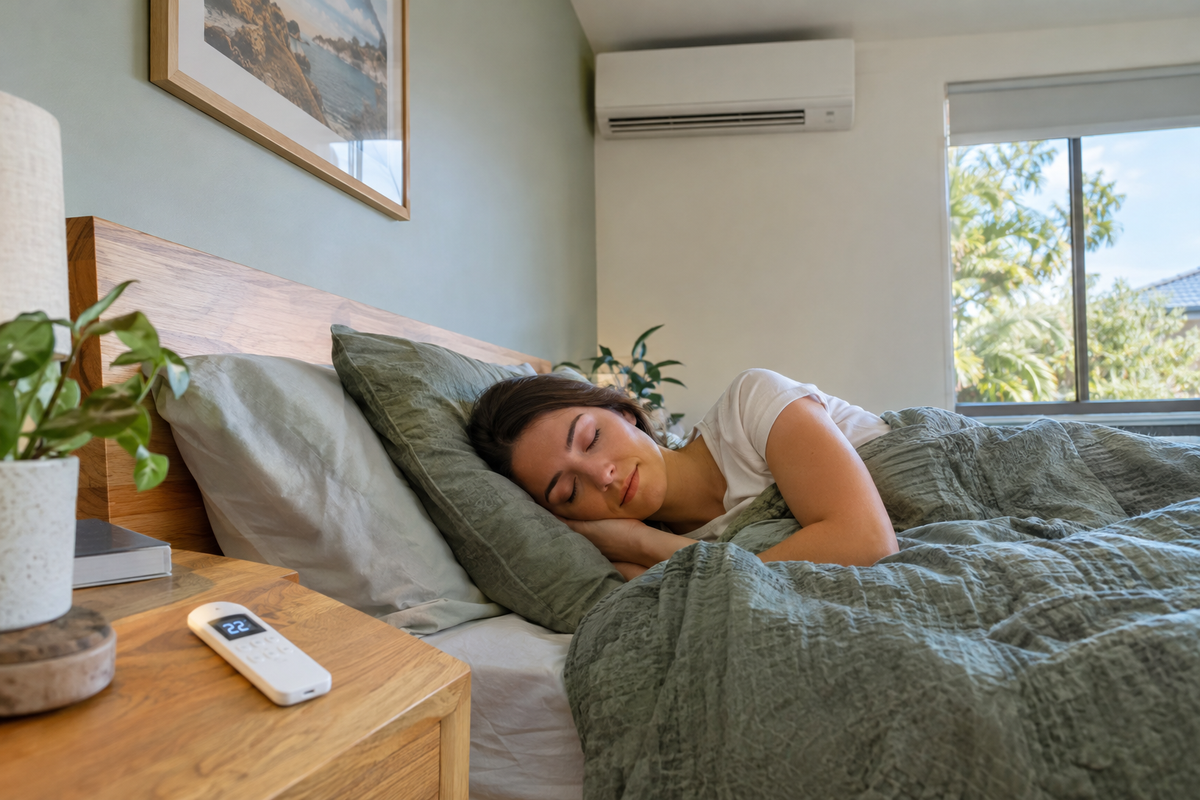
The best air conditioning temperature for sleeping is generally between 18°C and 22°C. While individual preferences vary, this range supports the body’s natural core temperature drop required for deep sleep. Factors like bedding, humidity, and the insulation level of your home influence whether you should aim for the lower or higher end of this thermal comfort spectrum.
Why 18 to 22 degrees is the optimal sleeping range
The human body operates on a circadian rhythm that naturally lowers your core temperature as you prepare for sleep. This physiological drop is a signal to the brain that it is time to rest. If a bedroom is too warm, the body struggles to shed this heat, leading to fragmented sleep and reduced time in deep REM stages. Most sleep experts and installers find that a setting between 18°C and 22°C provides the necessary heat gradient to allow the body to cool itself efficiently. Setting the unit lower than 18°C often leads to the compressor running continuously, which can cause the air to become excessively dry and irritate the respiratory system.
In many Australian homes, the choice of bedding significantly dictates where you should land in this range. A heavy down doona in a southern winter might require a setting of 18°C to prevent overheating, whereas a light cotton sheet in a tropical summer might feel more comfortable at 22°C. The goal is not to make the room cold, but to create an environment where your body does not have to work to regulate its temperature. When the ambient air is roughly 20°C, the skin can easily release heat without the heart rate increasing to facilitate cooling. We often see homeowners setting their systems to 16°C in an attempt to cool the room faster, but this does not actually speed up the cooling process; it simply ensures the system stays at high capacity for longer, often overshooting the comfort zone and wasting energy.
How humidity levels change your perceived temperature
Temperature is only half of the comfort equation; the other half is relative humidity. In a humid coastal climate, 24°C can feel stifling because the moisture in the air prevents sweat from evaporating off your skin. Conversely, in a dry inland zone, 24°C might feel quite pleasant. This is why the best temperature for sleeping often feels different depending on where you live. A Darwin install fights humidity where a Canberra one fights winter chill. For those in high-humidity areas, using the 'Dry Mode' or 'Dehumidification' setting can be more effective for sleep than simply lowering the temperature. By removing moisture from the air, the system allows your body’s natural cooling mechanisms to work more effectively at a higher, more energy-efficient set point.
When we look at the latent heat load of a room, we are measuring the energy required to remove moisture. If your air conditioner is oversized for the bedroom, it may reach the target temperature too quickly and shut off before it has had a chance to remove enough humidity. This results in a room that is cold but 'clammy'. To avoid this, modern inverter systems are designed to ramp down and run at a lower capacity, maintaining a steady temperature while consistently pulling moisture from the air. If you find yourself waking up feeling sticky despite a low temperature setting, the issue is likely humidity control rather than the thermostat setting itself. Adjusting the fan speed to a lower setting can also help, as it allows the air more 'dwell time' over the cold evaporator coils, maximising moisture removal.
Why your home construction affects overnight cooling
The physical materials of your home play a massive role in how your air conditioner performs overnight. A double brick home has high thermal mass, meaning it absorbs heat all day and radiates it back into the rooms long after the sun has set. If you are sleeping in a room with an uninsulated brick internal wall, that wall is essentially a radiator. In these homes, you may need to start your air conditioning an hour before bed to 'pre-cool' the thermal mass of the structure. In contrast, a lightweight weatherboard or cladding home reacts much faster to the air conditioner but also loses its cool air quickly if the system is turned off.
Roof construction is another critical factor. In many 1990s-era builds, a dark tiled roof without adequate ventilation can see roof cavity temperatures reach 70°C during a summer day. Even with R3.5 or R4.0 insulation in the ceiling, that heat will eventually migrate into the bedrooms. If you have a split system air conditioning unit in a bedroom, it has to fight this constant downward radiant heat. Homes with light-coloured Colorbond roofs and reflective foil laminate (sarking) generally have a lower ambient heat load, allowing the air conditioner to maintain a steady 20°C with much less effort. If your home lacks ceiling insulation, you will find that no matter how low you set the temperature, the room will feel 'heavy' because the ceiling itself is hot, radiating infrared heat directly onto your bed.
How system type and airflow impact sleep quality
The delivery of air is just as important as the temperature on the display. In a ducted air conditioning system, air is typically delivered through ceiling vents. If these vents are positioned directly over the bed, the 'dump' of cold air can cause muscle stiffness or wake the sleeper. Ideally, vents should be positioned to wash the walls or windows with air, cooling the room's envelope rather than the person. Most modern systems allow for fan speed adjustment; for sleeping, a low or 'quiet' fan speed is preferable. This reduces the wind-chill factor, which can make 22°C feel like 18°C if the air is blowing directly on you.
Inverter technology has changed how we set temperatures for sleep. Older fixed-speed 'on/off' systems would wait for the room to warm up by 2 degrees before kicking back on at 100% capacity, leading to a seesaw effect of being too hot and then too cold. Modern inverters can pulse at as little as 10% of their total capacity, maintaining the temperature within a fraction of a degree. This steady state is far superior for maintaining deep sleep. If you are using a system that is more than 15 years old, you might find the best temperature is harder to pin down because the fluctuations are so wide. In these cases, setting the temperature slightly higher (around 23°C) can sometimes mitigate the harshness of the cold air blasts when the compressor cycles on.
Managing heat gain in west-facing bedrooms
Bedrooms that face west are notoriously difficult to keep cool for sleep. These rooms absorb the full force of the afternoon sun, often through large glass windows that act like greenhouses. By the time you go to bed at 9:00 PM or 10:00 PM, the glass and the internal plasterboard are still holding significant heat. Even if you set the air conditioner to 20°C, the 'mean radiant temperature' of the room remains high. This is why some people feel they need to set their AC to 16°C just to feel comfortable; they are trying to compensate for the heat radiating off the walls and windows.
To optimise your sleep environment in a west-facing room, external shading is the most effective tool. Eaves, awnings, or even outdoor shutters can stop the sun from hitting the glass in the first place. Internally, heavy block-out curtains with a white backing can reflect some of the heat. From an installer's perspective, we often recommend a slightly larger capacity unit for west-facing bedrooms to ensure the system can overcome this specific heat load. If the unit is undersized, it will struggle to reach the 20°C target until well after midnight, meaning you spend the first few hours of your sleep cycle in an uncomfortably warm room. Reviewing our product catalogue can help you identify units with high-static pressure or better airflow throw to reach across these difficult rooms.
Why sensor placement determines your actual comfort
A common complaint is that the air conditioner says it is 20°C, but the room feels like 24°C. This usually happens because the temperature sensor is located inside the indoor unit, which is often mounted high on a wall near the ceiling. Since heat rises, the air at the ceiling is always warmer than the air at the level of the bed. Furthermore, if the unit is tucked into a corner or near a wardrobe, it may be sensing a 'pocket' of air that doesn't represent the whole room. This is where a regular air conditioning service becomes vital, as a technician can check if sensors are calibrated correctly or if dust buildup is insulating the thermistor and giving false readings.
Many modern split systems now feature a 'Follow Me' or 'I-Feel' function on the remote control. This shifts the temperature sensing from the wall unit to the remote itself. By placing the remote on your bedside table, the air conditioner will continue to run until the air at your actual sleeping level reaches the target temperature. This often results in a much more accurate and comfortable sleep. If your system doesn't have this feature, you may need to experiment by setting the unit 1 or 2 degrees lower than your target to account for the temperature gradient between the ceiling and the floor. Understanding these technical nuances allows you to set your system more intelligently, ensuring you get the restorative sleep you need without unnecessary power consumption.
Common questions
Is 24 degrees too hot for sleeping?
For most people, 24°C is slightly above the ideal range for deep sleep, but it can work if the humidity is very low. In a humid environment, 24°C will likely feel too warm as it hinders the body's ability to shed core heat through the skin.
Should I use Sleep Mode on my air conditioner?
Yes, Sleep Mode is designed to follow your body's rhythm. It typically increases the set temperature by 0.5 or 1 degree per hour for the first two hours, preventing you from waking up feeling too cold in the early morning when ambient temperatures naturally drop.
Is it expensive to run the AC all night?
Modern inverter systems are very efficient once they reach their target temperature. Running a bedroom unit at 22°C overnight often costs less than a dollar, as the system only uses a small amount of power to maintain the steady state rather than cooling from scratch.
Why do I wake up with a dry throat when using AC?
This usually happens because the temperature is set too low, causing the unit to remove too much moisture. Aiming for 20°C to 22°C and ensuring the fan speed is on a lower setting can help maintain a healthier humidity level for your respiratory system.
Does the age of my air conditioner affect sleep quality?
Older non-inverter units cycle on and off abruptly, causing temperature swings of several degrees. This can disturb light sleepers. Newer inverter technology maintains a consistent temperature, which is far better for staying in deep sleep cycles throughout the night.