Optimal air conditioning temperature for sleep in Australian homes
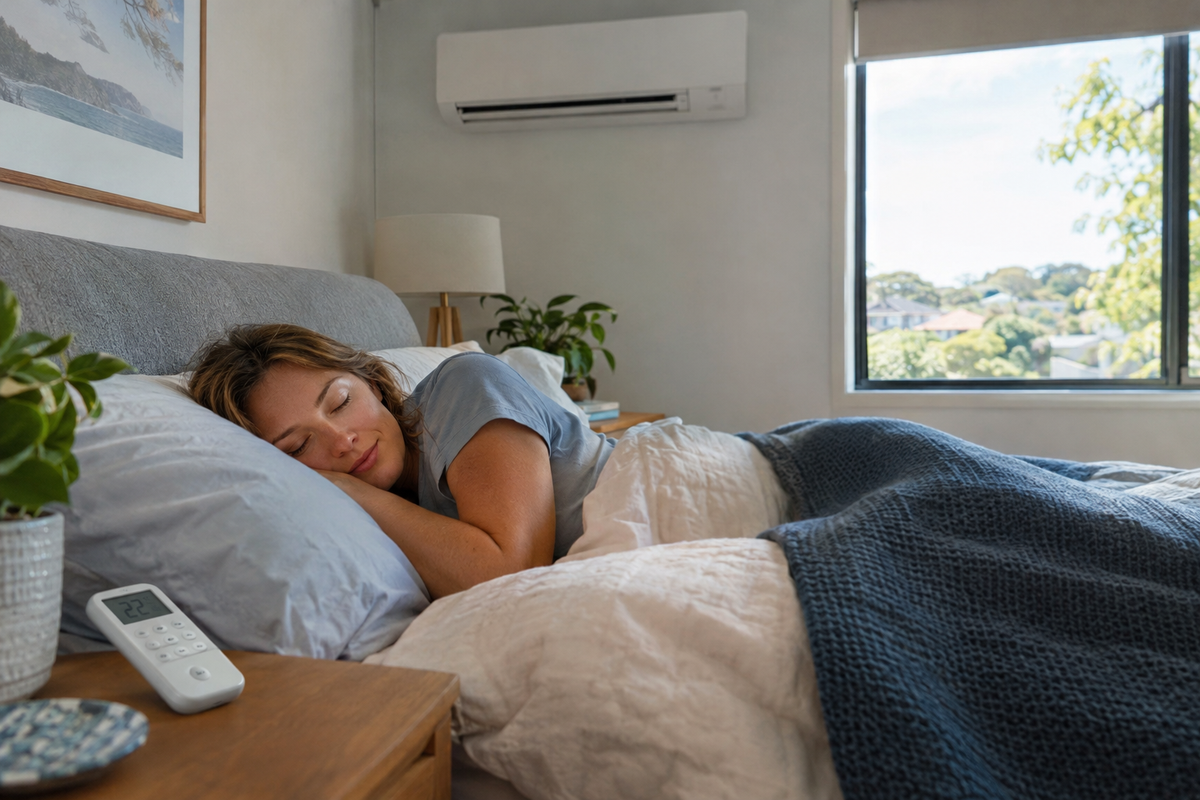
For most people, the best air conditioning temperature for sleeping is between 18 and 22 degrees Celsius. This range supports the body's natural drop in core temperature during the sleep cycle. While individual preference varies, setting your system within this bracket balances physical comfort with energy efficiency in most Australian building types and climate zones.
How biological cooling affects your sleep quality
Human biology is governed by a circadian rhythm that dictates our sleep-wake cycles. A significant part of this process involves thermoregulation, where the body naturally sheds heat as evening approaches to prepare for rest. Your core temperature needs to drop by approximately one to two degrees to initiate deep sleep. If the ambient temperature in your bedroom is too high, your body struggles to reach this lower threshold, leading to fragmented sleep, restlessness, and a lack of restorative REM cycles. This is why a room that feels comfortable at 4 PM can feel stifling by 2 AM.
In many Australian homes built before modern thermal performance standards, bedrooms can retain significant heat well into the night. A house with a low R-value in the ceiling—meaning poor insulation—will allow heat from the roof cavity to radiate downward long after the sun has set. Setting your air conditioner to a range of 18 to 22 degrees Celsius provides a heat sink that assists your body in dumping its internal warmth. For children and the elderly, who often have less efficient internal thermoregulation, staying closer to the 22-degree mark is usually recommended to prevent over-cooling, which can also disrupt sleep by triggering the body's wake-up response to cold.
Adjusting for humidity and coastal environments
The sensation of heat is not purely about the number on the thermostat; it is heavily influenced by moisture levels in the air. In a humid coastal climate, the high water vapour content prevents sweat from evaporating effectively, which is the body's primary cooling mechanism. This means that a room at 24 degrees in a tropical zone will feel significantly more uncomfortable than the same temperature in a dry inland area. For those living in areas with high humidity, the air conditioner performs a dual role: lowering the sensible heat (temperature) and removing latent heat (moisture).
When you compare different regions, the strategy changes. For example, a Darwin install fights constant high humidity where a Canberra one fights dry, biting winter air. In humid zones, you might find that setting the unit to 23 degrees on 'Dry Mode' provides better sleep quality than 20 degrees on 'Cool Mode'. Dry mode prioritises dehumidification, making the air feel crisp and allowing your skin to cool naturally. If you use a split system air conditioning unit in a bedroom, ensuring the louvres are not pointing directly at the bed can prevent the dry air from irritating your nasal passages while still maintaining the necessary moisture removal for the room.
The impact of building materials on overnight heat
Australian construction methods play a massive role in how hard your air conditioner has to work overnight. Homes with high thermal mass, such as double brick or those on a concrete slab, can absorb a tremendous amount of energy during a 35-degree day. This heat is then released slowly throughout the night. If you live in a double brick home, you may find you need to set the air conditioner a few degrees lower initially to 'pre-cool' the structural mass of the room before you actually climb into bed. Conversely, lightweight weatherboard or cladding homes cool down much faster but also heat up rapidly if the unit is turned off.
Roofing materials also dictate the thermal load. A dark tiled roof can reach temperatures of 70 degrees Celsius in the peak of summer, turning the roof cavity into a giant radiator sitting directly above your bedroom ceiling. Even with R4.0 or R5.0 insulation, some of that heat will eventually penetrate. If your home has a light-coloured Colorbond roof, the heat gain is lower, and the system won't have to work as hard to maintain your target sleep temperature. Understanding these factors helps you realise why your neighbour might be comfortable at 24 degrees while you need 20 degrees to achieve the same result in a different house type.
Balancing sleep comfort with electricity running costs
There is a direct correlation between your thermostat setting and the pressure on your wallet. As a general rule in the Australian HVAC industry, every degree you lower the thermostat in summer adds approximately 10% to the running costs of the system. If you habitually set your unit to 18 degrees when 22 degrees would suffice for comfortable sleep, you are potentially increasing your overnight energy consumption by 40%. For a large ducted air conditioning system covering multiple bedrooms, this can lead to a significant difference in quarterly power bills.
Modern inverter technology has changed the economics of overnight cooling. Unlike older fixed-speed compressors that blast on and off, an inverter ramps up to reach the target temperature and then slows down to a whisper to maintain it. This is far more efficient for maintaining a steady 20 or 21 degrees throughout the night. To optimise costs, we recommend starting the unit an hour before bed at your desired temperature and then using the 'sleep' function if available. This allows the system to settle into its most efficient low-power state before you even close your eyes, rather than forcing it to work at maximum capacity while you are trying to drift off.
Utilising sleep modes and fan speed settings
Most high-quality air conditioning units sold in Australia feature a dedicated 'Sleep Mode' or 'Night Setback' function. These programmes are designed to align with the human metabolic rate, which slows down during the early hours of the morning. Typically, a sleep mode will increase the set temperature by 0.5 or 1 degree every hour for the first two hours, eventually holding a slightly higher temperature than your initial setting. This prevents you from waking up at 4 AM feeling chilled, which is a common complaint when a system is left on a static low temperature all night.
Fan speed is the other critical component of sleep comfort. While a high fan speed cools a room quickly, it also creates more noise and can lead to excessive air movement that dries out the eyes and throat. Most modern split systems operate at around 19 to 21 decibels on their lowest fan setting, which is quieter than a whisper. If you find the noise of the air moving through the vents is keeping you awake, it may be time to book an air conditioning service to check for loose ductwork or obstructed filters. A well-maintained system should be felt but not heard, providing a gentle blanket of cool air rather than a focused jet.
Managing airflow and bedroom unit placement
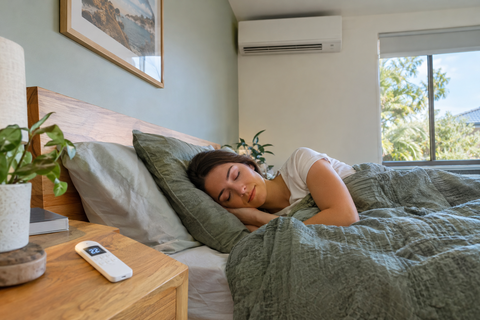
The physical location of the indoor unit or the ducted discharge vents can make or break your sleep quality. In a bedroom, the worst place for an air conditioner is directly above the headboard or pointing straight at the side of the bed. Direct airflow causes rapid evaporation of moisture from the skin, which can lead to muscle stiffness or 'stiff neck' in the morning. Ideally, the air should be directed to a neutral space in the room, such as toward a wardrobe or a foot-of-bed walkway, allowing the air to circulate and cool the room via convection rather than direct contact.
For those with multi-storey homes, the 'heat rises' principle means upper-floor bedrooms will always be harder to cool than those on the ground floor. If your system is struggling or making unusual noises while trying to maintain temperature on a top floor, it could indicate a refrigerant leak or a failing compressor, necessitating air conditioning repairs. In these scenarios, zoning becomes vital. A properly zoned ducted system allows you to shut off the living areas at night and concentrate all the cooling capacity into the bedrooms, which maximises efficiency and ensures the system can reach that 18-22 degree sweet spot even on the most oppressive summer nights.
Common questions
What is the cheapest temperature to run air con at night?
The most cost-effective temperature for overnight use is generally 24 degrees Celsius. While this is at the higher end of the comfort scale, it significantly reduces the workload on the compressor. Every degree you increase the thermostat saves roughly 10% on energy consumption, making 24 a good compromise between sleep comfort and lower electricity bills.
Is it healthy to sleep with air conditioning on?
Yes, provided the system is well-maintained. Sleeping in a room between 18 and 22 degrees supports the body's natural thermoregulation and can prevent heat-related sleep disruptions. However, ensure the filters are clean to maintain air quality and avoid pointing the airflow directly at your body to prevent skin and nasal dryness.
Why does my air conditioner feel too cold at night?
As you fall into a deep sleep, your metabolic rate drops and your body temperature decreases. A room that felt perfect at 10 PM may feel freezing at 3 AM. Using a 'Sleep Mode' helps by gradually increasing the temperature throughout the night to match your body's changing thermal needs.
How do I stop my air con from making noise while I sleep?
Ensure your unit is set to the lowest fan speed or 'Quiet' mode. If you hear rattling or whistling, it often indicates a dirty filter or an internal blockage. Regular professional servicing ensures the fan motor and bearings remain quiet, preventing the mechanical hum from disrupting your rest.