How much does ac cost per hour?

Running an air conditioner in Australia typically costs between $0.25 and $0.95 per hour for a split system, while ducted systems range from $1.50 to $4.50 per hour. These figures depend on your electricity tariff, the unit's energy rating, and the local climate. Larger ducted systems in poorly insulated homes will sit at the higher end of this scale.
Understanding the difference between cooling capacity and power draw
When calculating how much an air conditioner costs to run, the first thing to clarify is the difference between thermal capacity and electrical input. Most homeowners look at a unit labelled as 7kW and assume it consumes 7,000 watts of electricity every hour. In reality, modern reverse cycle systems use heat pump technology to move heat rather than creating it through resistance. This efficiency is measured by the Coefficient of Performance (COP) or the Energy Efficiency Ratio (EER). As of 2026, a high-efficiency system might have an EER of 4.0, meaning it produces 4kW of cooling for every 1kW of electricity it draws from the grid.
To find your actual hourly cost, you must look at the technical specifications for the 'rated input' rather than the 'rated capacity'. If a system has a rated input of 2kW and your electricity provider charges $0.35 per kilowatt-hour (kWh), that unit will cost $0.70 per hour to run at full load. However, because of inverter technology, a system rarely runs at full load for the entire hour. Once the room reaches the set point, the compressor slows down, often reducing the power draw to a fraction of its rated input. This makes the average hourly cost significantly lower than the peak cost.
We always advise clients to check their specific electricity bill, as tariffs vary significantly between peak and off-peak periods. If you are running your system during a hot afternoon when peak rates apply, your hourly cost could be 50% higher than if you were running it on a shoulder tariff or using power generated from an on-site solar array. Understanding these numbers is the only way to get an accurate picture of your household expenditure.
Hourly running costs for split system units
Split systems are the most common cooling solution for individual rooms or small open-plan areas. A small 2.5kW unit, typical for a bedroom, usually has a rated input of around 0.6kW. At an average electricity price of $0.35 per kWh, this unit costs roughly $0.21 per hour when running at capacity. In a well-insulated room, once the temperature stabilises, this draw might drop to 0.2kW, bringing the cost down to approximately $0.07 per hour. This is why a split system air conditioning installation is often the most budget-friendly way to manage climate in specific zones.
Larger split systems, such as those in the 7kW to 9kW range designed for large living areas, have a higher power draw. A 7.1kW unit might have a rated input of 2.1kW. Under heavy load, this translates to about $0.74 per hour. Over an eight-hour period on a humid day, you might expect to spend between $4.00 and $6.00, depending on how hard the unit has to work to maintain the temperature. The Zoned Energy Rating Label (ZERL) found on new units provides a more nuanced view by showing how the unit performs in different climate zones, such as hot-humid, temperate, or cold-dry environments.
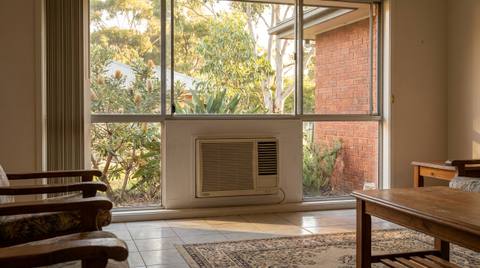
Efficiency is also impacted by the age of the unit. Older fixed-speed compressors do not have the ability to throttle down; they are either 100% on or 100% off. This 'all or nothing' approach results in frequent startup spikes and higher overall hourly costs compared to modern inverter units. When we assess a home, we often find that replacing a fifteen-year-old split system with a new high-efficiency model can halve the hourly running costs, even if the cooling capacity remains the same.
Calculating the hourly expense of ducted systems
Ducted air conditioning is designed to manage the climate of an entire home, and its hourly costs reflect that increased capacity. A standard 14kW ducted system for a four-bedroom home typically has a rated input of around 4kW to 5kW. At $0.35 per kWh, running the entire house at once can cost between $1.40 and $1.75 per hour. For larger homes requiring a 20kW system, the input might reach 6kW or 7kW, pushing the hourly cost toward $2.45. This is why understanding ducted air conditioning running costs is vital before choosing a system size.
Zoning is the most effective way to control these costs. A well-designed system allows you to turn off the air to the bedrooms during the day and the living areas at night. If you are only cooling two zones instead of six, the inverter compressor will realise the reduced load and drop its power consumption accordingly. A 14kW system running in a single-zone 'eco' mode might only draw 1.5kW of power, bringing the hourly cost down to roughly $0.53. Without smart zoning, you are effectively paying to cool empty rooms, which is the primary cause of high electricity bills.
It is also worth noting that many large ducted systems require a three-phase power supply. While three-phase power is more efficient for heavy loads and reduces the strain on the electrical grid, it does not inherently change the price you pay per kWh for electricity. However, it does allow for the installation of larger, more powerful compressors that can cool a large home faster, potentially allowing the system to reach its set point and throttle down sooner than a smaller, overworked single-phase unit would. You can browse our product range to see the input requirements for different capacities.
How your home construction influences hourly costs
Your air conditioner does not operate in a vacuum; it fights the heat load of your home. A house built with double brick has high thermal mass, meaning it stays cool longer but, once it heats up, it requires more energy to cool down. Conversely, a brick veneer or weatherboard home reacts quickly to outside temperature changes. In a humid coastal climate, the latent heat load (moisture in the air) means the AC must work harder to dehumidify the space before it can effectively lower the temperature. This dehumidification process consumes significant energy, increasing the hourly cost compared to a dry inland climate.
Roof construction is another major driver of cost. A dark tiled roof can reach temperatures of 70 degrees Celsius in mid-summer, radiating heat directly into the roof cavity where your indoor unit and ducting are located. If your ducting is poorly insulated (R1.0 or R1.5), the cool air inside the ducts gains heat before it even reaches your rooms. Upgrading to R2.0 or R2.5 rated ducting and ensuring the roof space is ventilated can reduce the workload on the compressor. A Darwin install fights humidity where a Canberra one fights winter, but in both cases, the insulation levels in the ceiling determine how long the compressor stays at high speed.
Windows are the weakest point in the thermal envelope. Large expanses of west-facing glass act like heaters in the afternoon. If you have single-glazed windows without eaves or shading, your air conditioner might never reach its set point, forcing it to run at 100% capacity for hours on end. By simply closing heavy curtains or installing external blinds, you can reduce the thermal load, allowing the inverter to drop into a lower power state and significantly reducing the hourly cost of operation.
The impact of thermostat settings and inverter technology
The temperature you set on your wall controller is the single biggest variable you can control. For every degree you drop the thermostat in summer, you increase the hourly running cost by approximately 10%. Setting the system to 24°C instead of 21°C can be the difference between a $0.80 hourly cost and a $1.10 hourly cost. In most Australian climates, 24°C is the recommended balance between comfort and efficiency. The goal of the system is to remove the 'edge' of the heat and control humidity, rather than creating a refrigerator-like environment.
Modern inverter technology is the reason we can achieve these lower hourly rates. Older systems were 'fixed speed', meaning the compressor ran at maximum power until the room reached the target temperature, then shut off completely. When the temperature rose again, it kicked back in with a massive surge of current. Inverters, however, act like a car's accelerator. They speed up to get the room to temperature, then ease off to a 'cruise' speed to maintain it. This steady-state operation is much cheaper per hour than the constant cycling of older technology.
To maximise this benefit, it is often better to turn the air conditioning on early in the day before the house heats up. If you wait until the internal temperature is 30°C, the system must work at maximum capacity for several hours to remove the heat stored in the furniture and walls. If you start the system when the house is 23°C, it can maintain that temperature using very low power, often keeping the hourly cost below $0.40 for a split system or $1.00 for a zoned ducted system throughout the entire afternoon.
Reducing hourly costs through regular maintenance
Neglecting maintenance is a guaranteed way to increase your hourly running costs. The most common culprit is a blocked return air filter. When the filter is clogged with dust, the fan has to work significantly harder to pull air through, increasing its electrical draw. More importantly, the reduced airflow means the system cannot exchange heat efficiently. This forces the compressor to run for longer periods and at higher speeds to achieve the same cooling effect. We have seen cases where a simple filter clean reduced a customer's hourly running cost by 20%.
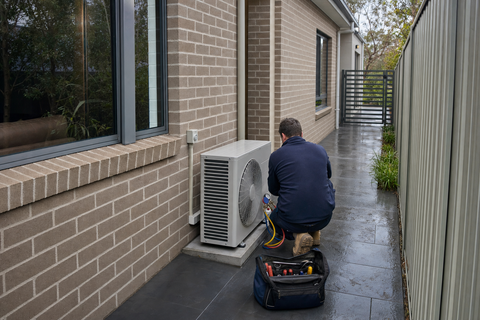
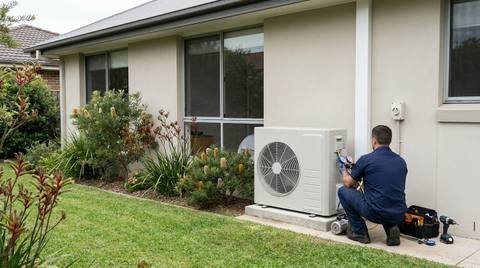
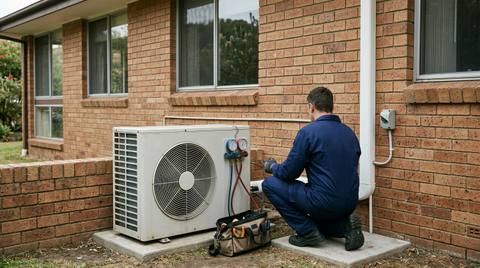
Outdoor units also require clear space to operate efficiently. If the outdoor condenser is surrounded by overgrown plants, stored boxes, or accumulated debris, it cannot dissipate the heat it has removed from your home. This causes the refrigerant temperature to rise, making the compressor work much harder. In coastal areas, salt spray can corrode the aluminium fins on the outdoor coil, reducing the heat exchange surface area. Regular professional air conditioning service includes cleaning these coils and checking refrigerant levels to ensure the system is operating at its peak efficiency.
Low refrigerant levels are another hidden cost driver. A system that is slightly undercharged will still provide cool air, but it will take much longer to reach the set point. The compressor may never receive the signal to slow down, meaning you are paying for 'peak' operation for the entire duration the system is on. By ensuring the mechanical components are in good condition, you ensure that the cents-per-hour you calculated when the system was new remain accurate for the life of the unit. A well-maintained system is not just about reliability; it is about protecting your daily budget.
Common questions
Does it cost more to start an air conditioner than to leave it running?
While there is a brief surge in power when a compressor starts, modern inverter systems are designed to handle this efficiently. It is generally cheaper to leave a system running at a higher set point (like 25°C) than to constantly turn it off and on manually. This allows the inverter to stay in a low-power maintenance mode rather than frequently ramping up to full capacity.
How much does dry mode cost compared to cool mode?
Dry mode focuses on removing humidity and usually runs the compressor at a lower, consistent speed. In humid coastal regions, this can be slightly cheaper per hour than cool mode because the system doesn't aim for a specific low temperature, but rather a reduction in moisture. However, in very hot weather, cool mode is necessary to maintain comfort, and the cost difference is often negligible.
Does using a ceiling fan with AC reduce the hourly cost?
Yes, using a ceiling fan allows you to set the air conditioner's thermostat about 2°C higher while maintaining the same level of comfort. Because every degree higher saves roughly 10% on energy usage, the small cost of running a fan (usually less than $0.02 per hour) is far outweighed by the savings on the air conditioning unit's power draw.
How do I calculate the exact hourly cost for my specific AC model?
Find the 'Rated Input' in kilowatts (kW) on the sticker on your outdoor unit or in the user manual. Multiply this number by your electricity rate (e.g., $0.35/kWh). This gives you the maximum hourly cost. Remember that once the room is cool, an inverter system will likely use only 30% to 60% of that figure on average.
Why is my ducted system costing more than $5 per hour?
High costs usually stem from cooling too many zones simultaneously, poor insulation, or an aging system. If you have a dark roof without ventilation and old R1.0 ducting, the heat gain is massive. Additionally, if the system is low on refrigerant or has dirty filters, the compressor will run at maximum speed indefinitely, significantly inflating the hourly expense.