Split system air conditioner installation cost
A standard back-to-back split system installation in Australia typically costs between $600 and $1,100 for labour and basic materials, excluding the unit itself. For a complete supply and install package, expect to pay between $1,400 for a 2.5kW bedroom unit and up to $3,800 for a large 8kW living area system, depending on brand and electrical complexity.
Why the back-to-back configuration is the baseline price
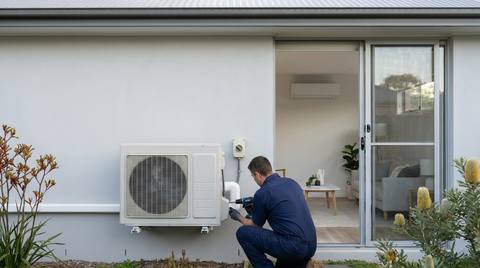
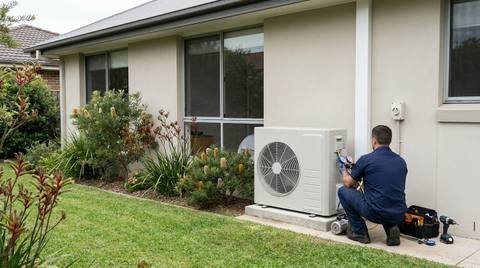
When you see a quote for a basic installation, it almost always assumes a back-to-back configuration. This is the simplest and most cost-effective way to install split system air conditioning because it requires the least amount of labour and materials. In this setup, the indoor unit is mounted on an external wall, and the outdoor compressor sits directly behind it on the ground or a wall bracket. Most installers include up to three metres of refrigerant piping and electrical cabling in their base price. This distance is usually sufficient to pass through a standard brick veneer or weatherboard wall and reach a unit sitting on a poly-slab at ground level.
Once the distance between the two units exceeds three metres, the price increases. Every additional metre of copper pipe, insulation, and cabling adds roughly $50 to $100 to the bill. This is because we have to manually flare the copper ends, join the lines, and ensure the refrigerant charge is sufficient for the longer run. If the outdoor unit cannot be placed directly behind the indoor unit—perhaps because of a driveway, a window, or an lack of airflow—the piping must be run through the roof cavity or along the external facade in decorative PVC ducting, known in the trade as slimduct. This adds both material costs and significant labour time, as securing pipework in a tight roof space or at height is a slower process than a straight-through-the-wall penetration.
How hardware capacity and brand selection change the quote
The physical size and cooling capacity of the unit are the primary drivers of the hardware cost. A 2.5kW unit designed for a small bedroom might cost $700 to $1,000 for the hardware alone, while a 7.1kW or 8kW unit for a large open-plan living area can cost between $1,800 and $2,800. Larger units are not just more expensive to buy; they are also heavier and more difficult to mount. A 2.5kW indoor head unit can be handled by one person, but an 8kW outdoor compressor can weigh over 60 kilograms, often requiring two installers to safely position it on a bracket or slab, which increases the labour component of the quote.
Brand choice creates a tiered pricing structure. Entry-level brands offer a lower upfront cost and are often perfectly suitable for guest bedrooms or rental properties where the unit is used occasionally. However, premium brands often justify their higher price point through better energy efficiency ratings and quieter operation. In a humid coastal environment, choosing a brand with high-quality anti-corrosion coatings on the outdoor heat exchanger is a better long-term investment than the cheapest available option. We often see budget units fail prematurely due to salt air corrosion in coastal suburbs, whereas a unit with specialised gold-fin or blue-fin protection might last several years longer. You should also consider package deals if you are installing multiple units, as this can reduce the per-unit labour cost significantly.
Electrical compliance and switchboard capacity requirements
A major hidden cost in split system installation is the electrical work required to meet AS/NZS 3000 standards. Small 2.5kW units can sometimes be added to an existing power circuit if the load allows, but most manufacturers and local regulations require a dedicated circuit back to the switchboard for anything larger. This means running a new 20A or 32A cable from the outdoor unit all the way back to your main electrical panel. If your home is an older build with an original fuse box, you may need a switchboard upgrade to accommodate the new circuit breakers and RCDs (Residual Current Devices). A switchboard upgrade can add $500 to $1,500 to the total project cost depending on the number of circuits being modernised.
Single-phase power is standard in most Australian residential homes, and it is usually sufficient for two or three split systems. However, if you are planning to install multiple large units or a high-capacity multi-head system, you may approach the limit of your home's incoming power supply. In some cases, a three-phase power upgrade is necessary, though this is rare for simple split system installs. The length of the electrical run also matters; if the switchboard is on the opposite side of the house from the air conditioner, the labour to crawl through the roof space or under the floor to pull the cable will be reflected in the quote. We always check the switchboard first because an inadequate power supply is a safety risk that cannot be ignored to save money.
Why wall construction and height affect labour costs
The material of your walls significantly impacts the time it takes to drill the 65mm or 80mm hole required for the piping and drains. Drilling through a single skin of timber weatherboard or fibre cement cladding takes minutes. Drilling through double brick, core-filled blocks, or reinforced concrete requires specialised diamond core drills and much more physical effort. If the installer hits a structural stud or a steel lintel, the process slows down further. We price these jobs differently because of the wear on expensive drill bits and the extra hour of labour often required to produce a clean, professional penetration through heavy masonry.
Height is another factor that moves the price. A ground-floor installation is straightforward, but if the indoor unit is on the second storey, we have to work from ladders or scaffolding to secure the external ducting and connect the outdoor unit. If the outdoor unit also needs to be wall-mounted at height, the risk and physical difficulty increase. In some apartment buildings or multi-storey townhouses, we may even need to use a scissor lift or specialised lifting equipment to get the compressor into position on a balcony or roof. These logistical challenges are why a quote for a second-storey bedroom is almost always $200 to $400 higher than a ground-floor equivalent.
The price of extra pipe runs and drainage solutions
Managing the water that condenses on the indoor coil is a critical part of the installation. In a standard setup, a gravity drain allows this water to flow through a pipe to the outside. However, if the indoor unit is mounted on an internal wall far from an exit point, gravity may not be enough. In these scenarios, we must install a condensate pump. These pumps are small, motorised units hidden inside the indoor head or the ducting that push the water up into the roof or across to a suitable drain point. A condensate pump adds roughly $250 to $400 to the cost and introduces a mechanical part that will eventually require servicing or replacement.
Similarly, the path the refrigerant pipes take can add complexity. If the pipes need to be hidden inside a wall cavity rather than run in external ducting, the labour increases because we have to "fish" the pipes through the wall or remove sections of plasterboard. While this results in a cleaner look, the cost of the extra labour and the potential need for a plasterer to patch and paint the wall afterwards can add hundreds to the final bill. We generally recommend external ducting for most retrofits because it is more accessible for future maintenance and significantly cheaper to install. If you are building or renovating, pre-piping the house before the internal linings go on is the most cost-effective way to achieve a hidden look.
How outdoor unit placement impacts long-term performance
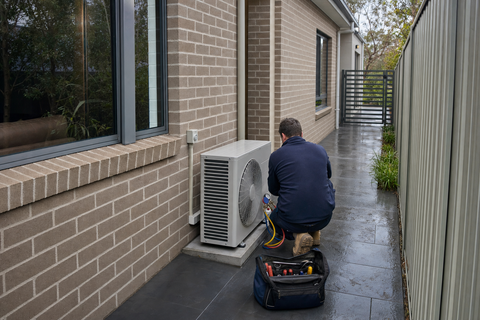
Where we put the outdoor unit affects more than just the installation price; it affects your electricity bills for the next decade. An outdoor unit that is crammed into a narrow side passage with poor airflow will struggle to shed heat. This causes the compressor to work harder, increasing wear and tear and spiking your power usage. If we have to spend extra time or materials to mount the unit on a bracket to keep it off the ground or clear of obstructions, it is a cost worth paying. For example, in a dry inland climate like Wagga Wagga, keeping the unit in the shade can improve efficiency during 40-degree summer peaks, whereas in a coastal city like Melbourne, protecting the unit from south-westerly salt spray is the priority.
Mounting options also vary in price. A basic poly-slab—a reinforced plastic base that sits on level ground—is the cheapest option. If the ground is uneven, we may need to pour a concrete pad or use adjustable rubber feet. Wall brackets are common for keeping units off the ground to prevent leaf litter buildup or to save space, but they must be bolted into structural members to prevent vibration and noise from transferring into the house. High-quality anti-vibration mounts are a small extra cost that we recommend for any wall-mounted unit, as they prevent the low-frequency hum that can be annoying in a quiet bedroom at night. Honest installers will explain these trade-offs, showing where a small extra spend now prevents a recurring headache later.
Common questions
Does the installation price usually include the air conditioning unit?
It depends on the quote. A 'supply and install' quote includes both the hardware and the labour. An 'install only' quote assumes you have already purchased the unit. Always clarify this, as the unit itself is often 60% to 70% of the total project cost for premium brands.
Why is a second-storey installation more expensive than a ground-floor one?
Second-storey installs require working at height, which involves more safety equipment and labour time. Installers must secure piping and ducting from ladders, and moving heavy outdoor units onto balconies or high brackets often requires two or three people instead of one, increasing the total labour hours.
Do I always need a new electrical circuit for a split system?
Most split systems over 3kW require a dedicated circuit to comply with Australian standards and manufacturer warranties. This prevents the air conditioner from overloading your existing power outlets. A dedicated circuit ensures the unit has a stable power supply and its own safety switch in the main board.
How much does extra piping cost if it's not a back-to-back install?
For runs longer than the standard three metres, you can expect to pay between $50 and $100 per additional metre. This covers the cost of the copper pipe, the thermal insulation, the electrical interconnecting cable, and the extra labour to secure the run and potentially add more refrigerant.
Is there a price difference between installing on brick versus weatherboard?
Yes, labour costs are generally higher for masonry. Drilling a large hole through double brick or concrete requires more time and specialised diamond-tipped tools compared to timber or fibre cement. While the difference might only be $50 to $100, it reflects the extra wear on equipment and the time taken.
For more detail, read our split system air conditioning guide.